
Daim Bar: History, Flavors & Varieties
Please leave a review or any memories of this snack in the comments at the end of this post.
Snack History Nostalgia Rating: ⭐⭐⭐☆☆
This Swedish candy bar is not sold in the US and might not be familiar to many people because of this. It is sold in the UK and in Sweden, and it has belonged to many companies since it was first created. This is a candy that is a lot like a Heath Bar, and its crunchy and chocolatey nature is very popular in the places that it is marketed.
Daim Bar would be a huge hit in the US as well, but there are a lot of competitors that share its general flavor profile and texture. There are many crunchy and chocolatey candy Bars like this on the market in the US, so it is likely not marketed to US customers for fear of it being too similar to other options.
| Daim Bar | Facts |
|---|---|
| Introduced | 1950 |
| Manufacturer | Marabou (original); now Mondelez International |
| Candy Type | Crunchy almond caramel covered in milk chocolate |
| Original Flavors | Milk chocolate with crunchy almond caramel center |
| Still Available | Yes, in Sweden, Norway, UK, Ireland, and various import markets |
| Country of Origin | Sweden |
| Parent Company | Mondelez International (since 2012) |
| Original Name | Dajm (renamed Daim in 1990; standardized globally in 2005) |
History
This is a Swedish/Norwegian candy bar. It is chocolate and has a caramel center that is lightly crunchy and includes almonds. The bar was created by a company called Marabou in Sweden. The product was released in 1950. This was always intended to be a product made to compete with the Heath Bar, which was very popular at the same time.
Crunchy candy bars were new and interesting at the time that the Daim Bar was made. The original Vice President of Marabou even inquired about licensing the Heath Bar for his own use in Sweden. The Heath Company refused to allow this, but they did share a list of the ingredients that they used in their Heath Bar product.
Marabou went ahead and created their own candy bar using the ingredients from the Heath Bar recipe. They tested until 1952 and finally found a product that they were happy with. The product they had created was sold in Sweden and Norway under the name Dajm. Finland received the product in 1963 and Denmark in 1971. It was renamed Daim in 1990. It was sold under the name “Dime” in the UK and Ireland.
Kraft Foods bought the product in 1993. Kraft then moved the candy bar to their spin-off called Mondelez International in 2012. The candy bar was given a boost in 1995 by a clever commercial that was directed by John Lloyd. The commercial featured Harry Enfield, who was a comedian. He was a salesman in the ad and explained that the candy bar was “smooth on the outside, crunchy on the inside”.
As of 2005, the name of the candy bar was changed in all markets to Daim. In 2007, the company made a Limited Edition Cappuccino Daim Bar. The company has also made a limited edition bar that is a forest fruit bar. There has also been Coke-branded Daim, a white chocolate Diam bar, a dark chocolate bar, a blueberry bar, and a lemon-orange bar. There has also been a mint Daim bar.
In the UK, a chocolate-orange Daim was sold recently, and this product was then sold in Ireland as well. There are many countries that import Daim Bars to sell, but they might not be able to access all the various flavors. Some of the limited edition options are only sold in one market.
Many people say that Hershey imitated the Daim Bar when it made its Skor Bar. This is another very similar product that can easily be interchanged with the Daim Bar, but that is not sold in all the same markets. The difference between Daim Bars and other candies is that Daim Bars are crunchier and more caramel-flavored than the other bars.
Quick Quiz
Which Of These Is The Oldest Candy?
Daim Bar Timeline
- 1950 — Marabou releases the candy bar in Sweden as Dajm
- 1952 — Final recipe completed after extensive testing
- 1963 — Product introduced to Finland
- 1971 — Product introduced to Denmark
- 1990 — Name changed from Dajm to Daim
- 1993 — Kraft Foods acquires the Daim Bar product
- 1995 — Clever commercial directed by John Lloyd featuring Harry Enfield
- 2005 — Name standardized to Daim across all global markets
- 2007 — Limited Edition Cappuccino Daim Bar released
- 2012 — Kraft transfers Daim Bar to spin-off Mondelez International
Daim Bar vs Heath Bar
| Feature | Daim Bar | Heath Bar |
|---|---|---|
| Texture | Crunchy almond caramel, milk chocolate coating | Crunchy toffee, milk chocolate coating |
| Introduced | 1950 | 1928 |
| Manufacturer | Mondelez International | Hershey Company |
| Flavors | Multiple including dark, white, mint, blueberry, and more | Primarily classic toffee; limited variations |
| Price Range | Varies by import market; typically £1–£2 in UK | Approximately $1–$2 USD in the US |
| Availability | Sweden, UK, Ireland, Norway, and select import markets | Widely available across the United States |
| Key Ingredient | Almond caramel | Butter toffee |
Variations
- Classic Daim Bar
- Dark Chocolate Daim
- White Chocolate Daim
- Coke Daim
- Blueberry Daim
- Lemon-Orange Daim
- Mint Daim
- Orange-Chocolate
Many of these specialty bars are not currently sold and were only offered briefly in limited markets. The variations that are offered in the UK and Ireland are often quite different than what is offered in other markets.
Daim bars are sold in many other variations in Sweden and Norway, and other markets have access to cakes as well as cookies. Daim cakes and Daim cookies are also sold alongside a wide list of ice cream variants in some markets. Most candy bars do not have large numbers of additional products that are sold surrounding them. The popularity of this candy has led to so many successful spin-off products in these other markets.
If you head to the UK or some of the other countries that sell Daim Bars, you might also be able to try a McFlurry that is made with various Daim Bar candies. There are various other combined products that are sold with Daim Bar candies in them in Sweden, Norway, the UK, and Ireland. There is also a Cadbury Daim bar that is sold called the Milka Daim Bar. This is a larger bar with Cadbury chocolate on it, and that is sold with the Cadbury purple livery behind the Daim logo.
The Milka Bar is sold in Germany, where Cadbury offers most of its more unique products like this one. You will likely not be able to access this version of the candy bar unless you order it and have it shipped long-distance to you. It does offer a unique flavor profile that is slightly different from the original candy bar and the various related spin-offs that are sold in other countries. Just the appearance of the wrapper and the marketing of this candy bar is a lot different and will put you more in mind of Cadbury than the Daim Bar.
Logo
Ingredients
From a seller called Joys Delights that offers the products for sale online:
- Sugar
- Palm oil
- Cocoa butter
- Cocoa mass
- Almonds
- Whey powder
- Skimmed milk powder
- Milk fat
- Modified whey
- Sweetened condensed skimmed milk
- Salt
- Emulsifier (soya lecithin)
- Flavorings
The other variants with unique flavors might have different ingredients. This is the ingredient list for the basic bar, which is the fundamental recipe behind the other bars.
Nutrition
| Serving Size: | 1 piece (6.3g) | % Daily Value* |
| Amount Per Serving | ||
| Calories from Fat | 18 | |
| Calories | 35 | |
| Total Fat | 2g | 3% |
| Saturated Fat | 1g | 5% |
| Trans Fat | 0g | |
| Cholesterol | 0.8mg | 0% |
| Sodium | 21.7mg | 1% |
| Total Carbohydrates | 3.8g | 1% |
| Dietary Fiber | 0g | 0% |
| Sugars | 3.8g | |
| Protein | 0.2g | |
| Vitamin A | 0% | |
| Vitamin C | 0% | |
| Calcium | 0.7% | |
| Iron | 0.3% |
- Percent Daily Values are based on a 2000 calorie diet.
Livery
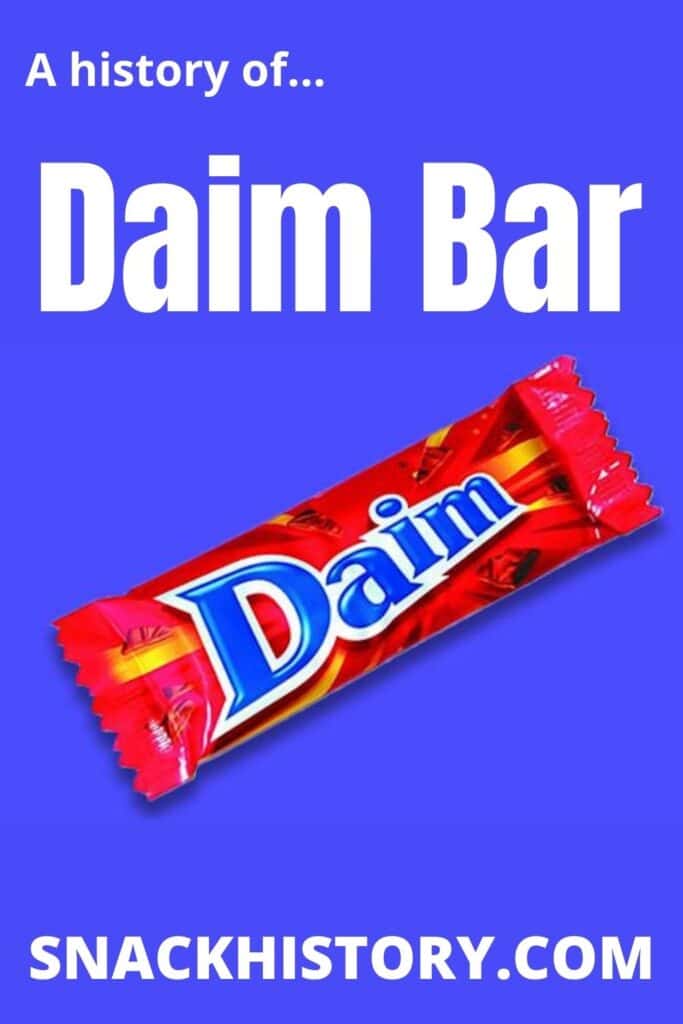
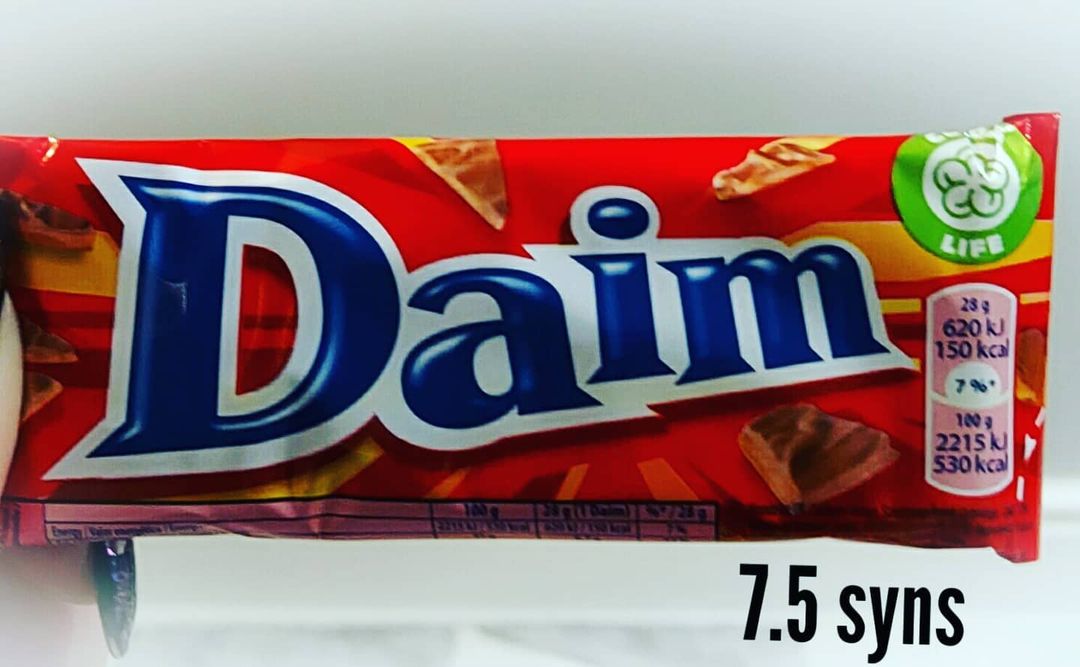
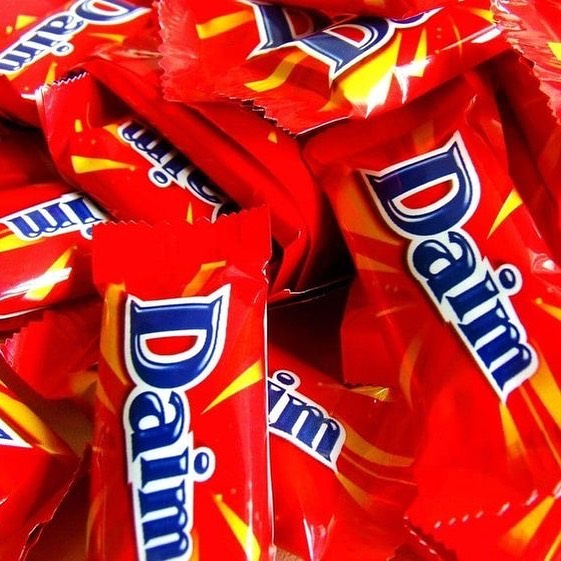
This product is sold with similar wrappers in almost every market that has access to it. The background of the wrapper is red, and the name of the product is declared in bold, blue lettering in the middle of the package. The appearance of the packaging did not vary much, even when it was called the Dime Bar in the UK.
The newer packaging shows some graphics in the background as well as images of the candy bar. This is a really simple marketing styling overall, and the candy bar looks different than a lot of other bars on the market. Most of the best candy bars are sold with simple wrappers like this, so maybe that is one of the key reasons for the product’s success.
Even during the periods where the products were sold under various names, the color scheme was the same, and the wrappers have been largely unchanged since this candy bar was first made. Even the various changes of ownership have not led to major shifts in the colors and design of the livery for the bar. The appearance of this candy is classic at this point, and people who love this candy bar connect the styling of its livery with the brand immediately.
What is the Daim Bar Like to Eat?
Many people report that the Daim bar is very crunchy and hard in the center. It breaks with a snap, and the layer of thin chocolate on the outside is buttery soft and very enjoyable. It is unique when compared to other similar bars because it is so thin and delicate. Being able to snap the bar easily and crunch on it a piece at a time is really enjoyable.
This candy is almost like peanut brittle in texture, but the flavor is like caramel. This is a really enjoyable product and one that is entirely it’s own despite the similarity of the other products on the market in various countries. Most American candy bars are much thicker and have more ingredients. The simplicity of this bar is what makes it so special in some ways, and that is the part that many people like best.
Many people prefer to break the candy bar into pieces and eat it one scrap at a time. This is because the center of the bar can be hard to chew and might have to be sucked on otherwise. You might also freeze this candy bar and then shatter it into lots of pieces. This is a common way to use this candy bar in baked goods and other recipes.
For those who want a candy bar that is not that sweet, this might not be a great choice. This is a very sweet candy bar and one that a sweet lover will gobble up. For those that love a more bitter chocolate or a slightly more mellow toffee, this might be a bit of a sweet bar.
Pictures
Commercials
The famous ad that made the bar more popular again:
Another 1992 ad with Harry Enfield:
Another Harry Enfield ad:
Frequently Asked Questions about Daim Bar
Why is the Daim Bar not sold in the United States?
The Daim Bar is not marketed in the US primarily because there are already many similar crunchy and chocolatey candy bars available in that market. The fear of the product being too similar to existing options, such as the Heath Bar and the Skor Bar, has likely discouraged its introduction. This crowded competitive landscape makes it difficult for the Daim Bar to carve out a unique position.
What is the origin of the Daim Bar and how was it created?
The Daim Bar was created by the Swedish company Marabou and first released in 1950. It was inspired by the Heath Bar, which was very popular at the time, and Marabou's Vice President had actually tried to license the Heath Bar recipe for use in Sweden. When the Heath Company refused but shared their ingredient list, Marabou used it as a basis for developing their own candy bar, finalizing the recipe by 1952.
What are the different flavors and varieties of Daim Bar available?
Daim Bar has been produced in a wide range of flavors including the Classic Daim Bar, Dark Chocolate, White Chocolate, Coke-branded, Blueberry, Lemon-Orange, Mint, and Orange-Chocolate varieties. A Limited Edition Cappuccino Daim Bar was also released in 2007, along with a forest fruit version. Many of these specialty bars were only offered briefly in limited markets, and the varieties available can differ significantly by country.
What companies have owned the Daim Bar over the years?
The Daim Bar was originally created and owned by the Swedish company Marabou when it launched in 1950. Kraft Foods acquired the product in 1993 and owned it for nearly two decades. In 2012, Kraft transferred the candy bar to its spin-off company, Mondelez International, which currently owns and distributes the product.
What other Daim-branded products exist beyond the original candy bar?
Beyond the classic candy bar, Daim has expanded into a wide range of spin-off products in various markets. These include Daim cakes, Daim cookies, and a variety of Daim ice cream products sold in countries such as Sweden, Norway, the UK, and Ireland. In some markets, a McFlurry made with Daim Bar candies is also available, and a Milka Daim Bar featuring Cadbury chocolate is sold in Germany.


Related Posts
Crispy Crunch Bar: History, Origin & Trivia
Please leave a review or any memories of this snack in the comments at the end of this post. Snack History Nostalgia Rating: ⭐⭐⭐⭐☆…
Read more
Honey Smacks Cereal: History, Facts & Brands
Please leave a review or any memories of this snack in the comments at the end of this post. Snack History Nostalgia Rating: ⭐⭐⭐⭐☆…
Read more
Nutty Buddy Cereal: History, Packaging & Brands
Please leave a review or any memories of this snack in the comments at the end of this post. Snack History Nostalgia Rating: ⭐⭐⭐☆☆…
Read more